The Anchor Buggy and Carriage Company
According to Samuel Levinson's son, Dr. Joseph E. Levinson, no Anchor Buggy and Carriage materials had been saved after his father's passing in 1964. Some vital information was found in his obituary. I've also relied on what was known by his son, Joseph E. Levinson, the Balterman family, from Anchor packaging, collectors, and items found on the Internet.
– Lizabeth West
An old city directory lists the Stuart company and Samuel L. Levinson at 9 E. Third Street in Cincinnati, Ohio, from approximately 1948 to 1954.* Levinson sold the Stuart company to Dexter Balterman in 1952-53, when the company was located at 215 W. Fourth Street. At that time Stuart was starting to switch from a series of 12 children's nightlights to miniature western toys (see the Stuart History page). When Balterman moved Stuart to 337 Fifth Street in 1958, due to increased western toy sales, Samuel Levinson retired from Stuart and stayed at the W. Fourth Street location to start The Anchor Buggy and Carriage Company, to create exact model carriage and buggy toys. Samuel Levinson had acquired permission to use the Anchor name in 1935. He was inspired by the prancing horses and carriages of his youth that once populated the streets of Cincinnati.
Levinson found a carriage maker in Lawrenceburg, Indiana, to make reduced scale carriage models. The carriage model parts were molded by the Seneca Plastic Company in Cambridge, Ohio. The Anchor horse was molded by Columbus Molded Plastics (founding name) in Columbus, Indiana. This name was shortened in 1951.* A record of an 8-part mold for a "Horse" for Sam Levinson was found in the old records.* The Anchor model parts were assembled into packaging in Cincinnati.
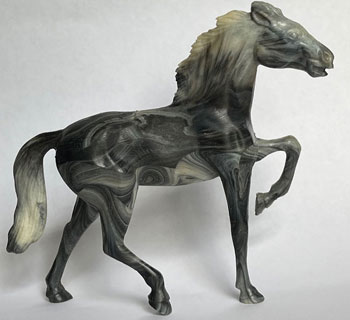
Though the Anchor prancing horse is similar to the Stuart walking horse, the Anchor horse is just under four inches tall, with the right rear hoof slightly raised. The mane and tail of the Anchor horse is flowing straigher back, indicating more speed than the Stuart walking horse. The definition in the head and body of the Anchor horse is more subtle than the harply-defined Stuart walking horse features. Known Anchor horse colors are white (most common), black, silver, and the not as common solid gray and marbled gray.
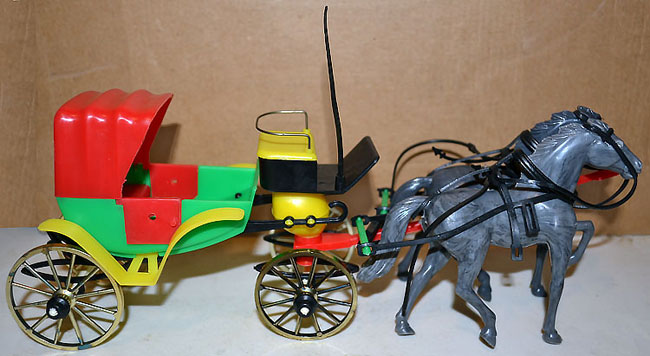
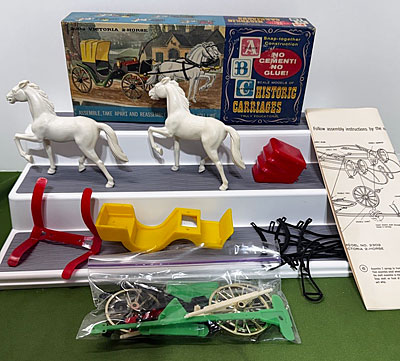
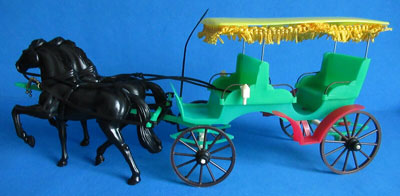
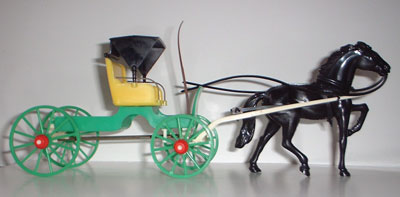
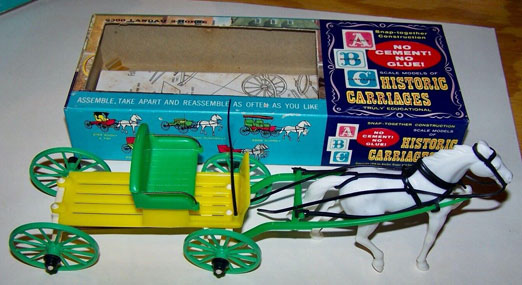
Anchor made colorful plastic carriage parts which snapped together for easy assembly. They could be purchased assembled or as a kit. The detachable rubbery harnesses in black or brown were made for Anchor solid-bodied prancing horses. These models were sold in toy stores, department stores and hobby shops.
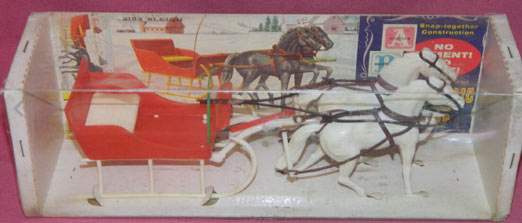
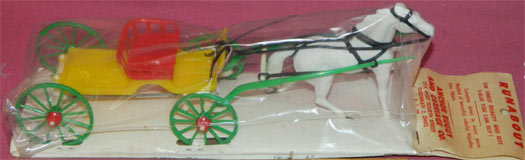
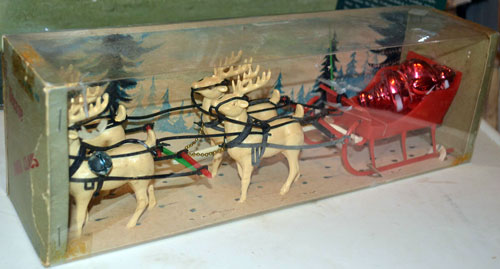
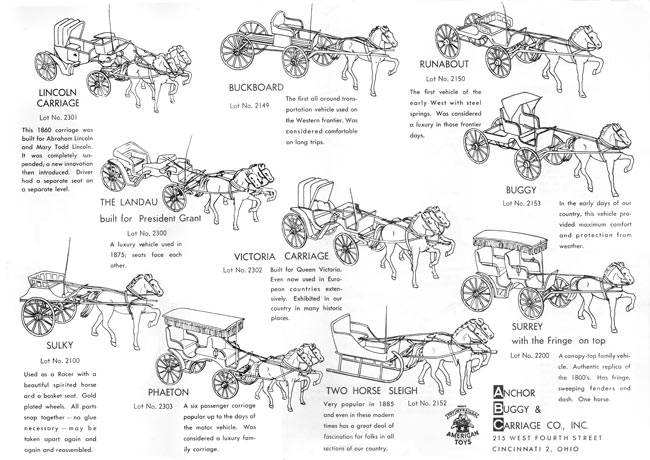
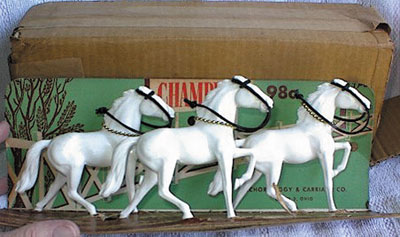
The known sets listed from the ABC closed box sheet inserts are: Two Horse Sleigh (popular in 1885). Some sleigh sets came with 2 blue jingle bells attached to a front chain of the horse harness but were not advertised on the model sheet insert; Runabout (first vehicle of the early West with steel springs); Buckboard (used in the Western frontier); Surrey (1800s canopy-top family vehicle); Sulky (used as a racer); Landau (built for President Grant); Phaeton (six-passenger carriage popular up to the days of the motor vehicle); Victoria Carriage (built for Queen Victoria); Lincoln Carriage (built for President Lincoln); Convertible; and Buggy.Anchor also sold a Welcome Santa Clause sleigh set with 4 hollow, hard plastic reindeer, a sleigh, buggy whip, soft plastic harnesses, 2 blue bells, and an ornament-like Santa (see below). A Champions set, consisting of 3 white Anchor buggy horses was also made by Anchor.
According to Samuel Levinson's son, Joseph E. Levinson, Anchor models were especially popular in the Pennsylvania and Ohio Mennonite areas. There was some interest in marketing Anchor model carriages in Europe. Anchor 1/72 scale knockoff models were made in Hong Kong. Samuel Levinson retired from his Anchor company in 1963 and passed away in 1964. The photos on this page show known sets and Anchor packaging.
*Please note: Some of my original Stuart research at this website has been omitted or altered due to a 2019 publishing copyright. (See the Stuart History page for information concerning content on this website.
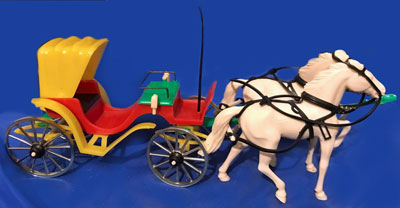
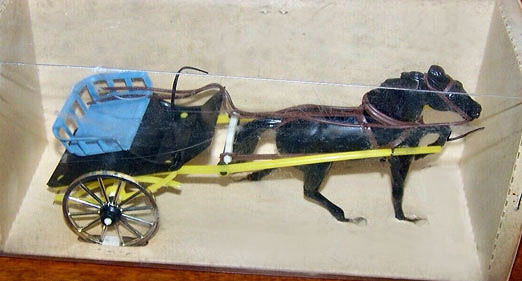
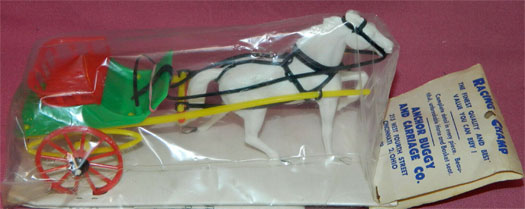 A Racing Champ (Sulky) set. (a recent packaging discovery.)
(Photo by Glenn Myers, trash-n-treasures.com.)
A Racing Champ (Sulky) set. (a recent packaging discovery.)
(Photo by Glenn Myers, trash-n-treasures.com.)