Stuart History
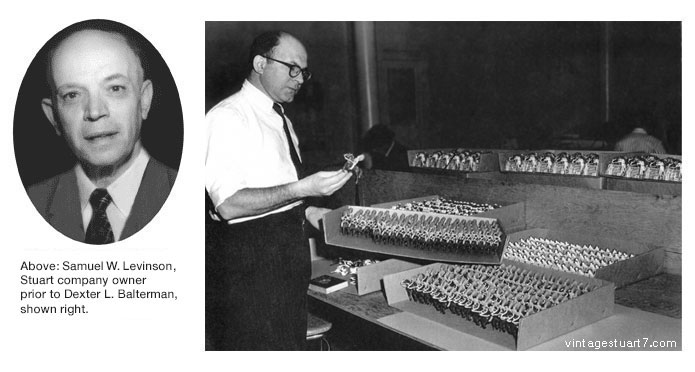
The Stuart Company and Samuel Levinson, was listed in an old 1948 city directory at 9 E. Third Street in Cincinnati.* The Stuart Company was producing a series of 12 children's night lights at 215 W. Fourth Street when Levinson sold the company to Dexter L. Balterman in 1952-53. (Mr. Balterman thought he purchased Stuart in 1952, which goes along with the Stuart product time line. A local newspaper article reported that it was 1953.)
A 1953 Post Cereals premium, advertised as a Roy Rogers Ranch Set, was created by another company for Post Cereals and ended in 1954.* (See the Post Premium page.) The premium plastic toys were then offered to Stuart by president, James Russell, of Columbus Molded Plastics, in Columbus, Indiana (founding name in 1946).* Stuart did not market these newly acquired plastic figures and horses as such, but sold them in sets like Texas TV Rancher, Home on the Range, Canadian Mounty and with their own designed western miniature toy line. (See Stuart Sets.)
The Stuart designed walking horse is three and a quarter inches tall, The Stuart rider is two and one sixteenth inches tall. Stuart figure accessories included a cowboy hat, feathered headdress, coonskin cap, kepi (cavalry or Civil War hat), tomahawk and rifle. Other Stuart designed accessories included a pack saddle, packs (luggage), and travois. Balterman researched his western toys to insure historical accuracy. Columbus Molded Plastics, in Columbus, Indiana, also did the western toy molding for Stuart. Columbus Molded Plastics shortened it's name in 1951.* The assembly into packaging was done in Cincinnati at The Stuart Company.* Stuart's slogan was "Stuart Quality is First Quality".
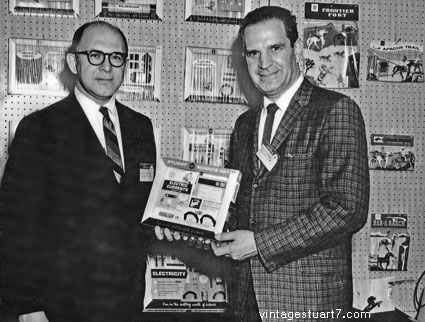
Dexter Balterman, left, and salesman, Murray
Richards, right,
at the N.Y. Toy Fair with the 1960 toys.
In addition to the western toy miniatures, The Stuart Company also made quality science sets in a variety of sizes and prices. Dexter Balterman was a chemist before he acquired Stuart. I was told that he was proud of the quality, affordable Stuart science sets, which ranged from small blister packs to large boxed sets. Additional Stuart products during the 1950s and 1960s included a Wonder Wheel Designer (spirograph), Bazooka, Spin-a-Plates (circus style), Jr. Gearshift, Changeabout Doll Houses and a Stuart's Prize Animal Farm (with a hard plastic horse, dog, sheep, cow and bull. (See the Other Products page.)
Increased Western toy sales in 1958 prompted a move to larger quarters at 337 Fifth Street. Balterman hired Phillip D. Gossard as plant manager, to help him run Stuart. Samuel Levinson left Stuart and stayed at the 215 Fourth Street address to start another company – The Anchor Buggy and Carriage Company. Levinson had acquired permission to use the name in 1935, to make exact Anchor model carriages and horses. These models were made from approximately 1958 to 1963. Samuel Levinson passed away in 1964. (See Anchor History.)
According to Andrew Balterman, western toy sales declined in the 1960s and Stuart found it increasingly hard to compete with larger toy companies. Stuart changed direction again to industrial packaging. When Stuart relocated to 1455 Dalton Street, the company was already in packaging production. The Stuart company was sold to plant manager, Phillip D. Gossard, a few years before Dexter Balterman retired in 1969. The Stuart Manufacturing Company is still in business on Patterson Street and is owned by Gossard's son, Phillip G. Gossard.
In 2000, Phillip D. Gossard thought the western toy molds were not passed on to anyone else. His son, Phillip G. Gossard, looked inside the old Stuart building but did not find molds, nor the walking horse sculpture. Steve Bluhm (of the Indiana products molding company) told me that molds are either sent back to the owner, passed on to another company or scrapped, and he had no way of knowing what happened to them from what remained of the old records. He also told me that things were very busy at the molding company as the staff had been downsized. I later learned that the company closed it's doors in 2001.
I was fortunate to have been in contact with the Baltermans before Dexter Balterman passed in 2003. He was surprised to hear how the western toys are still loved and collected, and that there was a website called Those Elusive Stuarts.
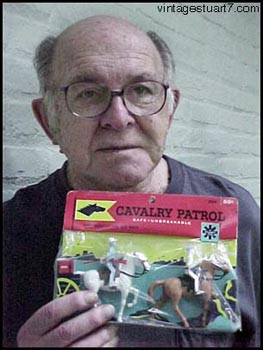
Dexter L. Balterman in 2000, with
a 1960 Cavalry Patrol set.
*Please note: I've had to omit or alter some of my original research at this website due to a 2019 publishing copyright.
--------
ACKNOWLEDGEMENTS: Andrew Balterman provided Stuart information, materials and photos, digital images, some newspaper clippings, and pointed me in some other directions during Stuart research. Without information from Dexter and Alice Balterman, Joseph Levinson, Phillip D. Gossard, Phillip G. Gossard, Clarence F. Block and John Block, Mrs. Elsie Russell, Steve Bluhm, and Catherine Wilson (Como Plastics), more details of this history would have been lost. Thanks to the Cincinnati Historical Museum for their help; Collectors and dealers of Stuart, Anchor and Post Premiums also filled in pieces of the puzzle and pointed me to Cincinnati. My gratitude to Tom Terry – Plastic Figure and Playset Collector Magazine (Sept.-Oct. 2000, no. 68 issue and June 2001, No. 72 issue), and Rusty and Kathy Kern – Playset Magazine (Oct. 2009, no. 47 issue), who helped me get Stuart information to the public.
I was given permission by the original Stuart connected families, and others, to use this material. Please do not use this material or photos without permission, and give credit to Lizabeth West, vintagestuart7.com.
---------